
42200-T6P-H51 Rear Wheel Hub Bearing for Honda Crider
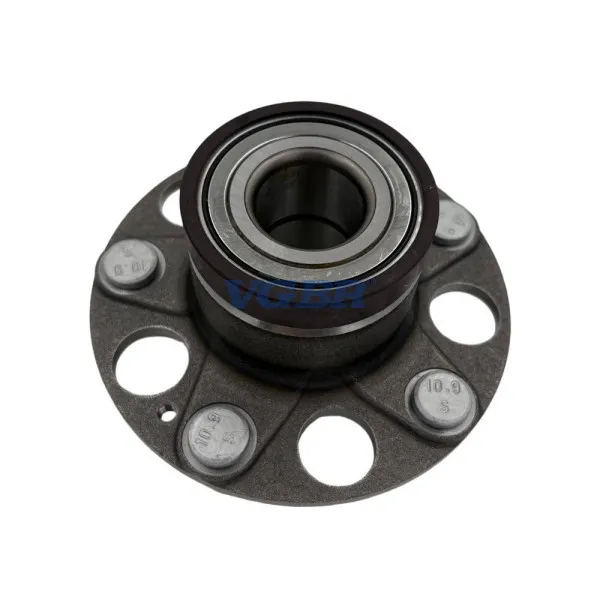
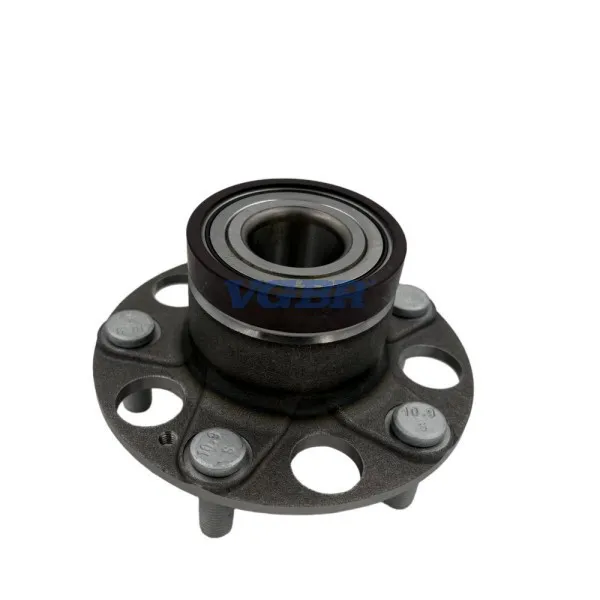
The 42200-T6P-H51 rear wheel hub bearing is a complete, non-driven hub unit for the five-stud Honda Crider (GJ5, GJ7) built for the Chinese market from 2013 to 2019. It is a bolt-on assembly: a 138.5 mm flange carrying five M12 × 1.5 wheel studs on a 114.3 mm pitch circle, four threaded mounting ears, a sealed double-row bearing cartridge and an integrated 96-tooth magnetic ABS encoder ring. There is no driveshaft spline and no external sensor cable, so the unit serves the rear axle only. Left and right are identical, which means one part number covers both sides of the car.
Honda used several 42200-series rear hubs across overlapping platforms, and aftermarket catalogues frequently mix the five-stud and four-stud families. That distinction is the single most important check on this number. A Crider or a Civic VIII uses five wheel studs, while Fit, Jazz, City and Insight of the same years use four. Cross-check the OE stamping on the old hub, count the wheel studs, and confirm the bolt circle before placing an order. The sections below explain every visible feature of this unit and how to verify it against a vehicle.
Product Specifications
The figures below come from the three photographs of the unit and from the published technical data for the GSP 9230180 equivalent, which lists Honda 42200T6PH51 as its OE reference. Where a trading catalogue rounds a dimension differently, the manufacturer figure is used and the difference is noted.
| Item | Specification |
|---|---|
| OE part number | 42200-T6P-H51 (42200T6PH51) |
| Position | Rear axle, left and right identical |
| Unit type | Non-driven bolt-on hub unit with integrated wheel bearing |
| Flange / outer diameter | 138.5 mm (GSP); some trading catalogues quote 139 mm |
| Bolt hole circle | 114.3 mm, five studs |
| Wheel studs | 5 × M12 × 1.5, pressed into the flange |
| Mounting holes | 4 threaded holes in four cast ears; grade 10.9 bolt heads visible in the photographs |
| Bearing bore | 30 mm (catalogue figure for the bearing cartridge) |
| Overall height | 86.5 mm (catalogue figure) |
| Centre bore | Sealed bearing cartridge, no driveshaft splines, no open CV joint bore |
| ABS | Integrated 96-tooth magnetic encoder ring; wheel speed sensor sits in the knuckle, not on the hub |
| Bearing type | Sealed, pre-greased double-row ball bearing |
| Vehicle family | Honda Crider (GJ5, GJ7), 2013–2019 |
| Brake compatibility | Confirm rear drum or rear disc configuration by VIN and by the old part number |
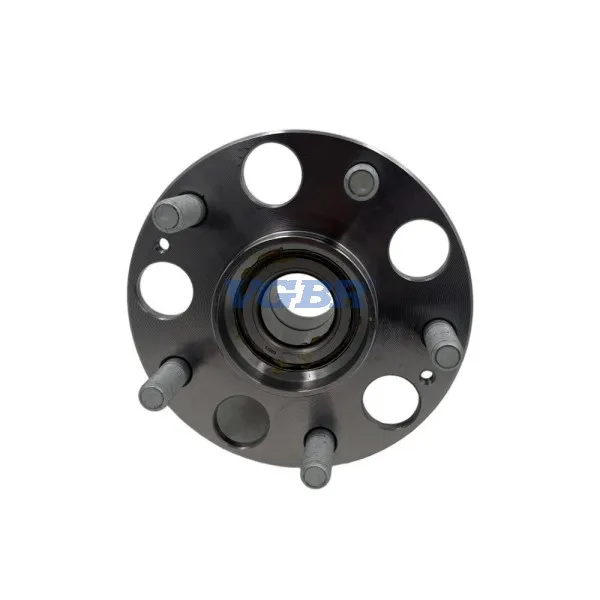
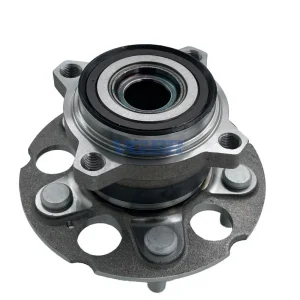
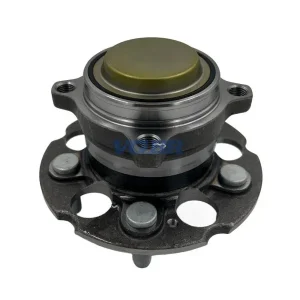
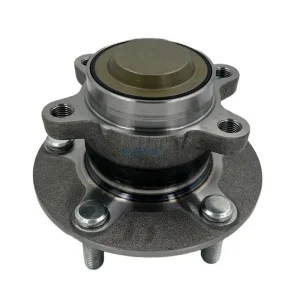
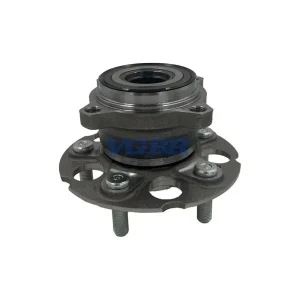
The three photographs show a black machined flange with five pressed-in studs, five large lightening holes, four raised ears with threaded bores, and a tall cylindrical bearing cartridge. The angled view shows the cartridge standing proud of the flange; the bearing-side view shows the open inner race of the sealed bearing. None of the three views shows a splined centre or a wiring harness. That combination matches the five-stud, 114.3 mm GSP specification and rules out the four-stud Fit / Jazz hub that shares several OE references in trading catalogues.
Published technical data for the 42200-T6P-H51 rear hub assembly lists the part as a two-row rear wheel hub with ABS provision for Honda applications, while the Crider application listing gives a 30 mm bore, 139 mm outside diameter and 86.5 mm height. Those numbers align with the photographed flange. The 138.5 mm figure comes from the GSP catalogue and is used here because it is tied to the exact OE number rather than to a generic hub family.
42200-T6P-H51 Interchange and Cross-Reference
Honda superseded hub numbers many times, and exporters often paste every 42200 reference they can find into one listing. The table separates the numbers that describe this five-stud casting from the numbers that belong to the four-stud compact-car hub. Treating the two groups as interchangeable is the most common cause of a wrong shipment on this part number.
| Reference | Where it comes from / how to treat it |
|---|---|
| 42200-T6P-H51, 42200T6PH51 | Primary Honda OE number and its unformatted version |
| GSP 9230180 | GSP hub listed against OE 42200T6PH51: 5 rim holes, 114.3 mm mounting bore spacing, 96-tooth ABS ring |
| WJ2730651 | Trading catalogue house number for the Crider rear hub, 30 / 139 / 86.5 mm |
| 42200-TF0-Z51, 42200-SLA-N01 | Honda numbers for the four-stud Fit / Insight / City rear hub — not this casting |
| 42200-TF0-N51, 42200-T5B-951 | Honda numbers for the four-stud Jazz rear hub — separate products in our catalogue |
| MOOG 512323, SKF BR930613, BCA WE60563 | Aftermarket numbers for the 4-stud, 4 × 100 mm compact-car hub — do not substitute |
| NTN HUB227-40, HUB227-39, FAG RW8323 | Bearing manufacturer numbers quoted in mixed listings — verify stud count before use |
| 42200-SCC-003, 42200-TF0-J51, 44200-SLA-N01 | Additional OE numbers appearing in multi-number export listings — confirm against the old unit |
The four-stud group is not a formatting difference. The MOOG 512323 specification states four wheel studs, a 100 mm bolt circle and a 138.7 mm flange, and our own 42200-TF0-N51 Jazz rear hub and 42200-T5B-951 Jazz rear hub photographs show four studs and four lightening holes. A five-stud wheel cannot be fitted to those units. When an enquiry quotes one of these numbers against a Crider, ask for a photograph of the old hub before quoting.
Vehicle Application Notes
The five-stud 42200-T6P-H51 is associated with the Honda Crider saloon built by GAC Honda on the GJ5 and GJ7 chassis. Several export listings also print Fit, Jazz, City, Insight and Freed beside the same OE number, but those models use the four-stud compact-car hub described above. The table records what can be stated with confidence and what must be checked per vehicle.
| Vehicle | Chassis / years | Fitment note |
|---|---|---|
| Honda Crider (GAC Honda) | GJ5, GJ7, 2013–2019 | Primary application in supplier catalogues; five studs on 114.3 mm |
| Honda Crider (GAC Honda) | 2014–2018 listings | Some exporters narrow the range to these model years; confirm by VIN |
| Honda Fit / Jazz / City / Insight | 2007–2014 in mixed listings | These are four-stud 4 × 100 mm cars; use the four-stud hub instead |
| Honda Civic VIII (FD, FA) | 2005–2012 | Also five studs, but a different OE number: 42200-SNA-A51 |
| Honda Spirior / Accord IX | CU5, CU6, CU7, CR1–CR3 | Also five studs, but a different casting: 42200-T2M-T51 |
For a wholesale order, the safest sequence is: read the OE stamping on the removed hub, count the wheel studs, measure the pitch circle, and compare the flange diameter. Then check whether the vehicle has rear disc or rear drum brakes, because the hub flange and the brake hardware differ across markets. Our guide to identifying wheel hub bearing OE numbers shows where Honda stamps these numbers and how to read superseded references. If the enquiry only gives a model name and a year, request a photograph before confirming the part.
Rear Unit or Front Hub: Telling Them Apart
A non-driven rear hub has a sealed, closed centre and no internal splines, because no driveshaft passes through it. A front hub on a front-wheel-drive Honda has a splined bore that accepts the CV joint, plus a different mounting flange. The photographs of 42200-T6P-H51 show a smooth sealed bearing cartridge with no teeth in the centre, four mounting ears and a magnetic encoder ring. That is a rear axle unit. Our front versus rear wheel hub bearing guide compares the two constructions side by side.
Confusion usually starts in a catalogue rather than in the workshop. Some exporters tag the same listing as both FRONT WHEEL HUB and Rear Wheel Hub so it appears in more searches. The physical part cannot be both. Count the studs, look for the splined bore, and check whether a sensor cable leaves the housing. A hub with a sealed centre, five studs and no cable belongs on the rear axle of a non-driven wheel. If the old part has a splined centre, this OE number is not the correct replacement.
Wholesale Supply and Inspection
VGBR supplies this hub as a catalogue item for distributors, importers and workshop chains. Prices are quoted on request because stock, quantity, packaging and destination all affect the final offer; the product page deliberately shows no retail price. Send the OE number, the required quantity and the destination port, and the sales team will reply with a quotation, lead time and packing details. Sample units can be arranged for fitment verification before a container order.
Each batch is checked for flange runout, bearing rotation, stud thread condition, encoder ring presence and seal integrity. Because the 96-tooth magnetic ring is inside the bearing seal, a missing or damaged encoder cannot be seen from the outside — the ABS warning light appears only after installation. Buyers who run their own incoming inspection should test the wheel speed signal on the vehicle before fitting the brake hardware. For mixed Honda orders, keep the five-stud and four-stud hubs in separate cartons with separate labels. Use the contact page to request a quotation or to send a photograph of the old unit for confirmation.
Frequently Asked Questions
Which Honda models use 42200-T6P-H51?
Supplier catalogues associate 42200-T6P-H51 with the five-stud Honda Crider saloon on the GJ5 and GJ7 chassis, built by GAC Honda from 2013 to 2019. Some listings also name Fit, Jazz, City, Insight and Freed, but those cars use a four-stud 4 × 100 mm rear hub. Confirm the OE stamping, the stud count and the VIN before ordering.
Is 42200-T6P-H51 a front or a rear hub?
It is a rear axle hub. The photographs show a sealed bearing cartridge with no driveshaft splines in the centre, five wheel studs and four threaded mounting ears. A front hub on a front-wheel-drive Honda has a splined bore for the CV joint. The absence of splines and of an external sensor cable confirms the non-driven rear position.
Why do some catalogues list 42200-T6P-H51 for Honda Fit or Jazz?
Because exporters copy large blocks of 42200-series OE numbers into one listing. The MOOG 512323 and SKF BR930613 hubs for Fit, Insight and Jazz have four wheel studs on a 100 mm bolt circle, while the GSP 9230180 hub listed against 42200T6PH51 has five rim holes on 114.3 mm. They are different castings. Count the studs on the old hub before accepting a cross-reference.
Does 42200-T6P-H51 include the ABS sensor?
The unit carries an integrated 96-tooth magnetic encoder ring inside the bearing seal. The active wheel speed sensor is mounted in the knuckle and reads that ring, so the hub itself has no external cable or connector. A damaged encoder ring causes an ABS fault after fitting, which is why the signal should be tested during incoming inspection.
Can I use 42200-TF0-N51 instead of 42200-T6P-H51?
No. 42200-TF0-N51 is the four-stud Jazz rear hub with four lightening holes and a 100 mm bolt circle. 42200-T6P-H51 has five studs, five lightening holes and a 114.3 mm pitch circle. The wheels and the flange do not match. Use the number stamped on the removed unit rather than a shared catalogue row.
Related Honda Wheel Hub Bearing Resources
Browse the Honda wheel hub bearing category for every 42200 and 44300 number we stock, or read the Honda wheel hub bearing supplier page for an overview of the platform. The Honda cross-reference catalogue lists all current numbers with their vehicle applications. The multi-number OE listing for 42200-T6P-H51 is a useful example of why the four-stud and five-stud references must be separated before ordering.
The 33406787015 rear wheel bearing (33406787015) is another rear reference worth comparing. It is a four-ear flanged bearing cartridge for the BMW X3 F25 and X4 F26, with no wheel studs and no splined bore; the hub is a separate component. This Crider part is a five-stud integrated hub assembly. Count the mounting holes and the wheel studs rather than matching by axle position alone.
Reviews
There are no reviews yet.