
B45A-33-04X Front Wheel Hub Bearing for Mazda 3 and CX-3
B45A-33-04X is a front wheel hub bearing assembly for the Mazda 3 (BM and BN, 2013–2019) and the Mazda CX-3 (DK, 2015 onwards). It is a complete bolt-on unit: the wheel hub, five M12 × 1.5 wheel studs, a sealed double-row ball bearing and a four-bolt mounting flange are supplied already assembled, so no press is needed during fitting. Published catalogues list a 138.6 mm flange diameter, a 42.7 mm flange offset, a 67.9 mm brake pilot and a splined centre bore that takes the driveshaft. The same part fits the left and right side of the front axle, which means one reference covers both wheels.
The number is written in two ways — B45A-33-04X with separators and B45A3304X without — and both mean the same Mazda part. Several Mazda references sit very close to it: BJS7-33-04X, BKC6-33-04X, BPM5-33-04XA and BPM5-33-04X all appear on listings for this hub. Trading catalogues do not always agree on which of these is the original equipment number, so start from the stamping on the removed unit rather than from a title. Our guide on how to identify wheel hub bearing OE numbers explains how to read those digits before matching them to a vehicle.
Product Specifications
The table below combines the three product photographs with published catalogue data for the SKF VKBA 7705, FAG 713 1227 10, Febest 0582-BMF and Timken HA590523 equivalents, all of which name B45A-33-04X as an OE reference. Where catalogues quote a different datum or a rounded figure, the difference is noted instead of being hidden.
| Item | Specification |
|---|---|
| OE part number | B45A-33-04X / B45A3304X |
| Related Mazda numbers | BJS7-33-04X, BKC6-33-04X, BPM5-33-04XA, BPM5-33-04X |
| Position | Front axle, left and right identical; one unit per side |
| Unit type | Complete hub assembly with flange, five wheel studs and sealed bearing |
| Wheel studs | Five studs, M12 × 1.5, bolt circle 5 × 114.3 mm (5 × 4.5 in) |
| Flange mounting | Four threaded bolt holes on a four-ear flange |
| Flange diameter | 138.6 mm; some catalogues round this to 138 mm |
| Flange offset | 42.7 mm |
| Brake pilot diameter | 67.9 mm |
| Hub pilot diameter | Approximately 91 mm (3.6 in) |
| Centre bore | Splined bore for the driveshaft, about 30 mm inner diameter |
| Bearing type | Sealed, pre-greased double-row ball bearing, 55# and GCr15 chrome steel |
| ABS | Magnetic encoder ring in the bearing seal; no external sensor plug or cable on the hub |
| Weight | About 3.0 kg per unit |
| Vehicle family | Mazda 3 BM/BN (2013–2019) and Mazda CX-3 DK (2015 onwards) |
| Not confirmed | Mazda 6 GJ and all-wheel-drive variants that appear on some trading lists; verify by VIN before ordering |
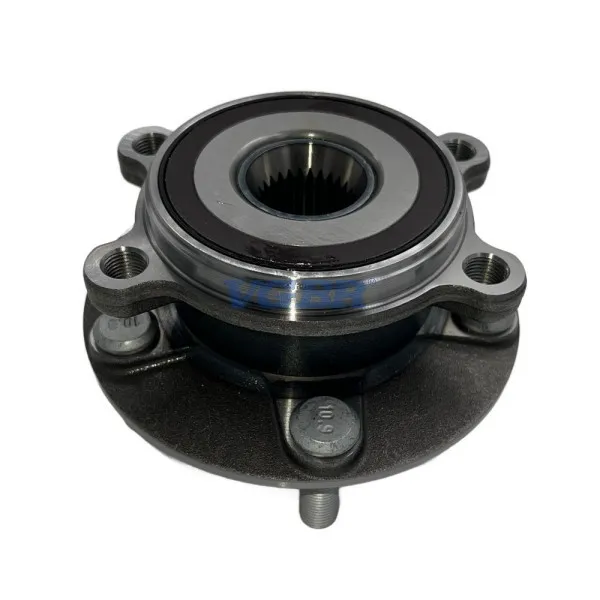
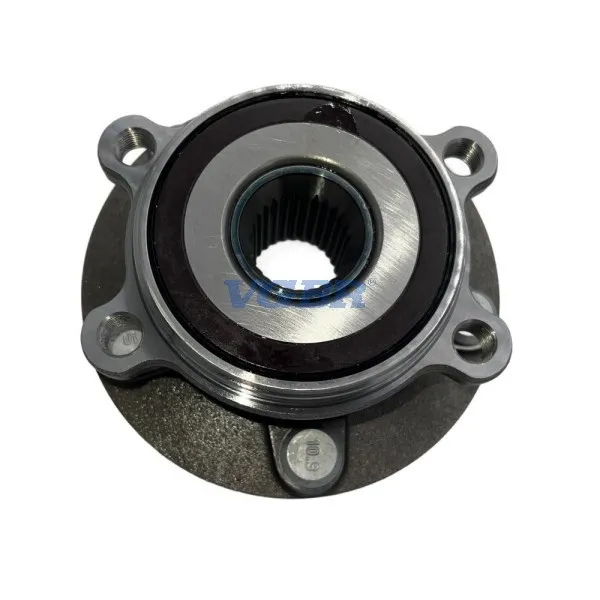
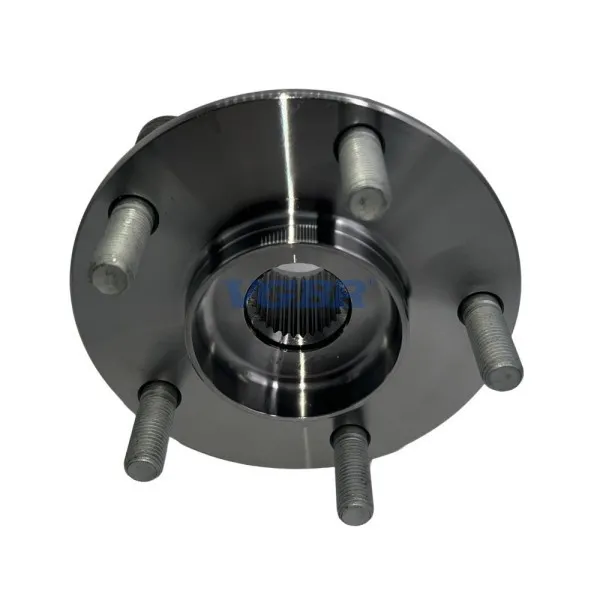
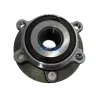
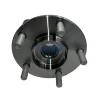
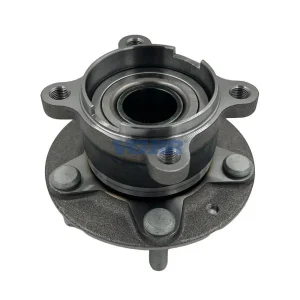
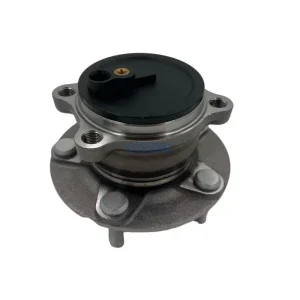
The first photograph shows the bearing face: a cast flange with a threaded hole in each of its four ears, a black seal around the bearing and a splined bore in the centre. The second view repeats the same face from a slightly higher angle and confirms that the four ears sit on a single machined plane. The third photograph turns the unit over and shows the wheel-mount side, where all five studs are pressed into the hub face around the splined bore. No sensor cable, plug or toothed ring is visible in any of the three views, which is consistent with an encoder built into the bearing seal and a wheel speed sensor that stays in the knuckle.
B45A-33-04X Interchange and Cross-Reference
Workshops usually search by the brand and number printed on the box they already have, so the common equivalents are collected below. The lists are long because this hub is used on one of Mazda’s highest-volume front axles, and not every supplier maps the numbers in the same way. Match the stamped OE number first, then use a cross-reference to confirm.
| Brand | Reference number |
|---|---|
| Mazda (OE) | B45A-33-04X, B45A3304X, BJS7-33-04X, BKC6-33-04X, BPM5-33-04XA, BPM5-33-04X |
| SKF | VKBA 7705 |
| Schaeffler FAG | 713 1227 10, 713 6159 80 |
| SNR | R170.68, R170.85 |
| Timken | HA590523 |
| MOOG | MDWB12885 |
| Febest | 0582-BMF |
| Blue Print | ADBP820033 |
| FEBI Bilstein | 174780 |
| GSP | 9328032, 9328034 |
| Japanparts / Japko | KK-13031, 413031 |
| A.B.S. / Optimal | 201897, 911211 |
| NK / NPS / Metzger | 753232, M470A39, WM 2181 |
| Triscan / Kawe | 8530 50141 |
| Maxgear | 33-1208 |
| Industry number | 513354 |
Two published sources are worth reading before an order is confirmed. The SKF automotive aftermarket catalogue lists this axle under VKBA 7705 and is the reference most European distributors use when they quote a kit number. The Mazda global site is the authority on model and generation names, which matters here because the same hub is described under BM, BN and DK chassis codes rather than under model years alone.
Vehicle Application Notes
The application table comes from the vehicle lists published alongside those catalogue references. It covers the BM and BN Mazda 3 and the DK CX-3. Engine and drivetrain variations within a single model year are common on this platform, so the production date and the VIN remain the final authority when a vehicle sits at the end of a generation.
| Model | Chassis and years | Variants listed |
|---|---|---|
| Mazda 3 hatchback | BM, BN, 2013–2019 | 1.5 SKYACTIV-G, 1.5 SKYACTIV-D, 2.0 SKYACTIV-G, 2.2 SKYACTIV-D |
| Mazda 3 saloon | BM, BN, 2013–2019 | 1.5 and 2.0 petrol, 1.5 and 2.2 diesel |
| Mazda CX-3 | DK, 2015 onwards | 1.5 SKYACTIV-D, 2.0 SKYACTIV-G, front-wheel and all-wheel drive |
| Not this part | Mazda 2 DJ | Uses the D09H-33-04X front hub, a smaller flange |
| Not this part | Rear axle | Rear units such as KD31-26-15XA and BDWP-26-15X are separate references |
A buyer who works only from a model name can easily order the wrong unit, because Mazda used more than one front hub across this generation range. The D09H-33-04X front hub for the Mazda 2 looks similar in a photograph but has a smaller flange and a different stud pattern. On the rear axle the KD31-26-15XA rear hub for the CX-5 and the BDWP-26-15X rear hub for the CX-30 4WD show how far the rear designs diverge from this front assembly. Comparing the stud count, the flange diameter and the position before ordering removes most of that risk.
Front Hub Assembly or Rear Bearing: What the Photos Tell You
This reference is a complete front hub assembly, not a bare bearing cartridge. Three features settle the question. There are five wheel studs pressed into the hub face, which means the wheel bolts straight to the unit. There is a splined bore, because a front hub has to transmit drive from the driveshaft. And there are four threaded mounting holes in the flange, which take the bolts that hold the assembly to the knuckle. A rear bearing cartridge, by contrast, usually has a smooth bore, no studs and a different flange shape.
That distinction matters for buyers who also stock rear parts, because the two families are often confused when only the model name is quoted. Our front versus rear wheel hub bearing guide sets out the structural differences in more detail, including flange depth, spline design and sensor layout. If a quotation arrives without a photograph, ask for one: the presence or absence of the five studs is visible at a glance and prevents most wrong shipments.
The ABS layout is the second thing to confirm. On this application the wheel speed signal is generated by a magnetic encoder ring that forms part of the bearing seal, and the sensor itself is mounted in the knuckle. That is why the photographs show no plug, no cable and no toothed ring on the outside of the hub. Some trading catalogues therefore describe the same reference as a non-ABS hub, which is technically misleading but practically understandable. What matters is the specification of the original part on the vehicle: check whether the car uses an encoder ring in the bearing or a sensor ring on the shaft before the order is released.
Installation and ABS Checks
A bolt-on hub assembly is quicker to fit than a press-in bearing, but the preparation still decides how long it lasts. Clean the knuckle face and the bore, check that the mating surfaces are free of burrs and rust, and tighten the four mounting bolts evenly in stages rather than in a single pass. Fit the driveshaft nut to the torque figure given in the Mazda service data for the specific model, and never let the assembly hang on the driveshaft while the bolts are being lined up. Replace the nut where the manufacturer specifies a single-use fastener.
Once the unit is bolted up, spin the hub by hand before the wheel goes on. It should turn smoothly with no catch, no roughness and no detectable play. Then check the ABS signal: a hub fitted with a damaged seal, or one that has been dropped on the encoder side, can produce a wheel speed fault even though the bearing feels fine. Clear stored codes and compare live wheel speed readings across the front axle during a short road test.
The usual reasons this hub is replaced are a humming or droning noise that rises with road speed, play at the wheel when the car is jacked up, uneven front tyre wear, and an ABS or traction warning light. Because both sides normally cover the same mileage, workshops often replace the pair together. The reference is identical left and right, so two units are needed for a complete front axle service; confirm the quantity on the quotation before the order is released.
Wholesale Supply and Incoming Inspection
VGBR Bearing lists this reference in a display catalogue, so prices are quoted per request rather than shown on the page. Send the OE number, the quantity, the destination market and, where possible, a photograph of the stamping on the old part. A quotation can then cover neutral packing, branded cartons, mixed-reference order lists and the shipping option that suits the destination. Distributors building a Mazda programme can combine this hub with the other references in the Mazda wheel hub bearing category.
Incoming inspection should cover five points: the five studs and their thread, the four flange bolt holes, the 138.6 mm flange diameter and 42.7 mm offset, the splined bore, and the condition of the seal that carries the encoder ring. Turn the unit by hand and listen for roughness, and check that the studs are pressed square rather than leaning. Our wheel hub bearing supplier buying checklist lists the documents, test reports and packing details to request from a factory before a container is booked.
Where a catalogue quotes a different flange diameter or weight, treat it as a difference in measurement datum or in what the kit contains rather than as a contradiction to be resolved by guessing. Ask the supplier which dimension is being quoted and compare it with the old part. Recording that one exchange on the purchase order prevents most fitment disputes later, and it gives the next repeat order a reliable baseline.
Frequently Asked Questions
Which Mazda models use B45A-33-04X?
B45A-33-04X is listed for the front axle of the Mazda 3 built on the BM and BN platform from 2013 to 2019, and for the Mazda CX-3 on the DK platform from 2015 onwards. It fits both sides of the front axle. Mazda 6 GJ and some all-wheel-drive variants appear on a few trading lists but are not confirmed, so check the VIN and the stamped OE number before ordering.
Is B45A-33-04X a front or a rear wheel hub?
It is a front hub assembly. The photographs show five wheel studs, a splined bore for the driveshaft and four threaded mounting holes in the flange. Rear units for the same brand use different references, such as KD31-26-15XA for the CX-5 and BDWP-26-15X for the CX-30 4WD, and they do not have a splined bore of this type.
Does B45A-33-04X come with the wheel studs?
Yes. The unit is supplied as a complete assembly with the flange, the five M12 × 1.5 wheel studs and the sealed bearing already pressed together. Nothing needs to be transferred from the old hub apart from the driveshaft nut and, on some models, the brake disc retaining screw. Confirm on the quotation whether the driveshaft nut is included.
Does this hub have an ABS sensor?
The hub carries a magnetic encoder ring in its bearing seal and has no external sensor plug or cable. The wheel speed sensor stays in the knuckle and reads that ring. Some catalogues describe the same reference as non-ABS because there is no harness on the hub, so confirm the ABS configuration of the original part on the vehicle rather than relying on the catalogue wording.
Which part numbers cross-reference to B45A-33-04X?
Common equivalents include SKF VKBA 7705, FAG 713 1227 10 and 713 6159 80, SNR R170.68, Timken HA590523, MOOG MDWB12885, Febest 0582-BMF, Blue Print ADBP820033, FEBI Bilstein 174780, GSP 9328032 and the industry number 513354. Mazda numbers BJS7-33-04X, BKC6-33-04X and BPM5-33-04XA also appear. Always match the stamped OE number first.
How do I confirm the right hub before ordering?
Read the stamping on the removed unit, count five studs and four flange bolt holes, measure the 138.6 mm flange and the 42.7 mm offset, and check that the centre bore is splined. Then confirm the chassis code and production date against the BM, BN or DK application list. A photograph of the old part next to a ruler settles most questions faster than a catalogue search.
Related Mazda Wheel Hub Bearing Resources
The links below help with matching, inspection and purchasing. The wheel hub bearings overview explains how the front and rear families differ, and the full product catalog lists every reference currently available. For a quotation, send the OE number, the quantity per reference and the destination market through the contact page.
- Mazda wheel hub bearings in this catalog
- D09H-33-04X front hub for the Mazda 2
- KD31-26-15XA rear hub for the Mazda CX-5
- BDWP-26-15X rear hub for the Mazda CX-30 4WD
- Front versus rear wheel hub bearing guide
- How to identify wheel hub bearing OE numbers
- Supplier buying checklist and incoming inspection

Reviews
There are no reviews yet.